
The 8 Keys
Retirement is about much more than stopping work. It is a major life transition that affects your identity, relationships, health, finances, routines and sense of purpose.
That is why Retirement Pathways has developed The 8 Keys to Successful Retirement: a practical framework designed to help you think about retirement as a whole-life stage, not just a financial milestone.
The 8 Keys bring together the areas that matter most when planning for a confident, balanced and fulfilling retirement. They include finances and legal matters, health and wellbeing, activities and structure, meaning and purpose, identity, managing change, social networks, and close family or partner relationships.
Some of these themes may already feel familiar from Retirement Pathways’ workshops and coaching. Others have been expanded through client conversations, experience and ongoing research, helping to create a more complete picture of what successful retirement can look like.
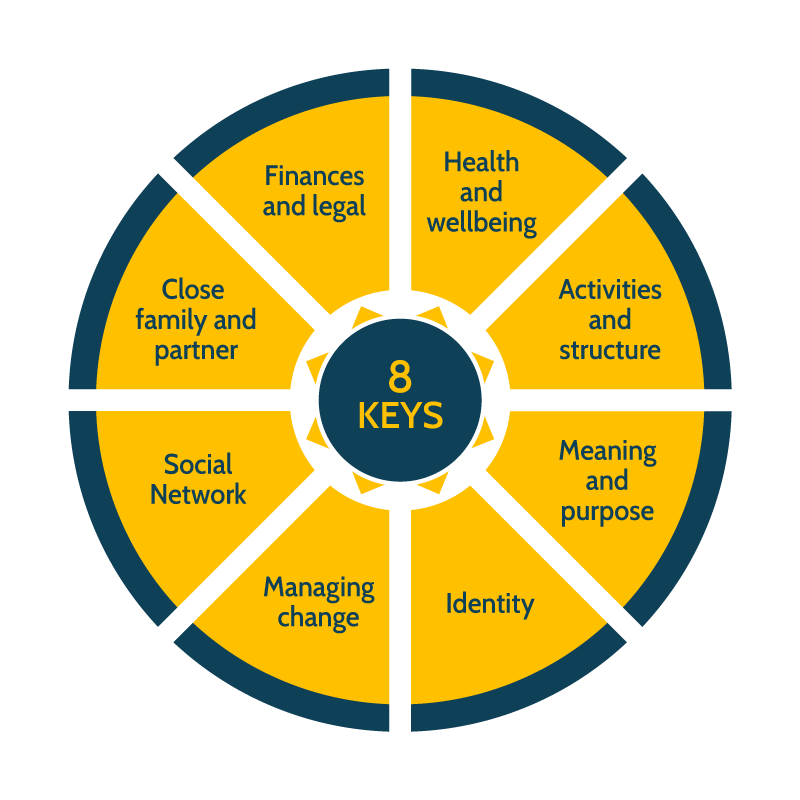
Each key includes a fuller description and clear success criteria, giving you a simple way to reflect on where you are now, what is working well and where more thought, planning or support may be helpful.
Whether you are approaching retirement, already retired, or supporting someone else through the transition, The 8 Keys offer a practical starting point for planning a retirement that feels secure, meaningful and truly your own.
Explore the 8 Keys below and use them as a guide for your own retirement planning journey. You can also move to the Key you want by clicking its button on the right of this page.

Health & Wellbeing
Health, along with finance, is one of the fundamentals of wellbeing in retirement in that ill health limits the extent to which we can do what we want in retirement. Individual people will have to make their own assessments as to how they manage any ill health that they bring into retirement or develop while retired and coaching can help them explore their options.
The main thrust of our approach to health and wellbeing is in relation to the 5 Pillars of Wellness – the things we can all do to try to keep ourselves well. In addition to those pillars, other elements of health and wellness include loneliness, dementia, bereavement, impact of ill health of one partner and care/later life. For organisations, this Key very much links into the wellness programmes that they might be running in house. in here

Activities & Structure
“What will I do” is usually the second question that people ask after “Will I run out of money?” and many people are anxious that they will be bored in retirement. This is one of the reasons that people go back to work if they cannot find meaningful activities to engage in. We emphasise that meaningful activity is more important than just being busy which may avoid boredom but may not be fulfilling.
We talk about picking up the things you never had time for, revisiting activities from when you were young, expanding on hobbies you already have and experimenting to find the activity that feels right for you. Things that link to your sense of purpose can often deliver the meaning that makes activities satisfying.

Meaning & Purpose
When we leave work, we often lose the sense of purpose that work can give us. That can leave us feeling adrift without a sense of direction or satisfaction and, in turn, that can lead to a dissatisfaction with retirement. Of course, many people already have a sense of purpose outside of work especially those that are involved in a faith or a cause.
A mistake that can be made is to think there is just one purpose to our life and what we need to do is find it. The reality is that purpose is different for different people and purpose in one stage of retirement might be different from purpose in a later stage.
Purpose does lead to fulfilment, and we can talk about 3 types of purpose in retirement:
The Greater Good – which is derived from a commitment to a faith or cause.
I Am Enough – which derives fulfilment from a life of enjoyable activity and /or personal growth.
An Interesting Life
How to find purpose can be easy or hard, quick or slow, and depends on who you are but there are some actions you can take to help you find your purpose.

Identity
In our society, many of us define who we are by what we do, we describe ourselves by our job title or function. This can be very difficult for many people when they retire, especially those who have been highly invested in their work. We hear many stories of how a doctor, lawyer, financial planner, engineer etc felt completely lost when they retired saying “I don’t know who I am anymore”.
Of course, we are not just who we are at work and there are many different aspects of our identity. We help people to think about who else they are, what their values and beliefs are and who they want to be in retirement. We encourage people to reconnect with those aspects of themselves and to build a new, positive retirement identity.

Managing Change
Retirement is a transition unlike any other we may have experienced in life. Change is about what happens and transition is about the psychological inner-reorientation that enables us to handle the change. That change involves ending some things, beginnings some things and undertaking that inner-reorientation which allows us to move from where we were to where we want to be.
We have all experienced changes in life and some of our experience of managing those changes will be helpful for making the transition to retirement but it can be a very difficult process and there is support available. Some will come from work, family and friends and some is available from Retirement Pathways.

Close Family & Partner
Relationships with partner and close family, as with friends, will go through the process of re-evaluation and adjustment as expectations emerge.
With a partner, it is likely that there will be more time together, depending on when both partners retire. While at work, many hours of the week will have been spent apart and finding themselves together more can put strain on the relationship. Divorce among retired people is the highest rate for any age group.
Understanding each other’s needs is an important first step and an open discussion to share expectations of each other, deciding what they will do together and what separately and negotiating on how they will be with each other will be useful. For example, if one partner wants to spend time travelling and the other doesn’t, it can be a source of very real tension
It is equally important to share expectations with close family. Many grandparents are now providing support by caring for grandchildren and there may be an expectation that this will happen. Alternatively, retirees may be thinking that they want to have more time with family and grandchildren but may find their family’s lives are already full with other activities.

Finances & Legal
Finance is the other fundamental for retirement. It will dictate how much money there is for daily life and for activities, hobbies and interests like travelling, sports, eating out, home improvements, supporting family etc.
As well as the state pension, many will have occupational pensions, savings, shares, property and other income. Understanding what all of that means for how much there is available for regular income and occasional spend allows retirees to be clear about what they can and can’t do.
Attitude to money is also important. People are used to saving for their pension during their working life and the switch from saving mode to spending mode can be difficult for some.
There are some legal actions that retirees need to deal with if they have not already done so. Lasting Power of Attorney puts measures into place so that, if the retiree becomes incapable, permanently or temporarily, to make their own decisions, then their Attorney has the legal right to make decisions for them. Incapacity could be through accident or illness and are usually unplanned.
Having a Will means that you can set out clearly what you want to happen to your money and other assets when you die. The majority of people do not have a Will or an up-to-date Will and that can be a problem. It is wrong to assume that things will automatically pass to your spouse. and it can be a lengthy process to sort out an estate in the person has died intestate.
Social Network
We all have a need for social connection. Some people like to have a wide group of friends and acquaintances while others prefer a smaller group of close friends. As we leave work we often talk about staying in touch, but the reality is that we will lose most, if not all, of our work connections.
If we have not developed our friendship network outside of work, we can be left with a friendship deficit and the need to make new friends or risk becoming isolated. It is not always easy to make new friends in retirement, and it may take quite a bit of time and energy to meet new people and build friendships.
We will probably also find that we go into a period of readjustment with our existing friends as our and their expectations of each other about how we and they will prioritise available time become clear